
If a part fails salt spray three weeks after coating, or the powder lifts in one sheet at the cross-cut, the argument usually starts at the gun or the powder batch. It should start at the first three meters of the line. The powder coating pretreatment process decides whether powder can bond at all; the booth, the powder and the oven only work inside the limit it sets.
Three things have to be true before a part reaches the booth. The surface has to be chemically clean. It has to carry a conversion layer the powder can key into. And it has to be free of soluble salts. A line can look busy and still fail all three — a part that beads water instead of holding a continuous film, a phosphate layer so thin it is only a color, a final rinse that has quietly become a chemical bath. When the film lifts rather than blisters, the order of checks is different: start with why powder coating peels off.
What does the powder coating pretreatment process actually do to a steel surface?
Cleaning and conversion are two different jobs, done in sequence, and most failures come from treating them as one.
In the powder coating pretreatment process, cleaning removes what should not be there: drawing lubricants, stamping oil, rust, mill scale, welding smoke, dust from the previous process. Conversion changes what is there. An acid bath reacts with the metal and precipitates a phosphate or zirconium layer that is chemically compatible with powder and slows the spread of corrosion under the film once it starts.
Soluble salts sit between the two. Chlorides and sulfates left on the surface draw moisture through the film, and the blister appears months later, usually blamed on the powder. A line can pass a visual inspection and still carry enough salt to fail a neutral salt spray test.
The quick field check is the water-break test: flood the surface with water and watch. A properly cleaned surface holds an unbroken film for around thirty seconds. If the film pulls back into droplets, there is still oil on the metal, and nothing downstream will fix it.
The stages, in order
A seven-stage powder coating pretreatment process is the common shape for steel. Aluminum and galvanized work usually needs its own chemistry in at least one of these positions, which this article covers further down.
| Stage | What it must deliver | What is controlled | How it fails |
|---|---|---|---|
| 1. Pre-degrease | Remove the bulk of loose soil before the main bath sees it | Spray pattern, temperature, drain time | Heavy oil carries into the degreaser and shortens its life |
| 2. Degrease | Saponify and emulsify oils and drawing lubricants | Free alkalinity, concentration, 45–60 °C, contact time | Saturated bath, cold bath, foam that blocks impingement |
| 3. Rinse 1 | Stop alkaline carry-over into the conversion stage | Overflow rate, pH drift | Stagnant rinse becomes a weak chemical bath |
| 4. Rinse 2 | Second dilution before conversion coating | Conductivity trend | Carry-over raises pH in the phosphate bath |
| 5. Conversion coating | Build the layer powder bonds to and corrosion protection needs | pH, temperature, coating weight, iron and sludge level | Coating too thin, patchy, or absent on one side of the part |
| 6. Final rinse | Remove soluble salts left by the conversion bath | Conductivity, flow, nozzle condition | Drying marks, flash rust, salt residue under the film |
| 7. Dry-off | Deliver a dry part with the conversion layer intact | Air temperature, dwell, part orientation | Trapped water in seams, over-dried and cracked coating |
Nothing in that table is exotic. What goes wrong is the interaction: a rinse that is slightly too dirty makes the conversion bath work harder, the operator tops the bath up with more chemical, the coating gets heavier and powdery, adhesion drops, and the report says the powder is at fault.
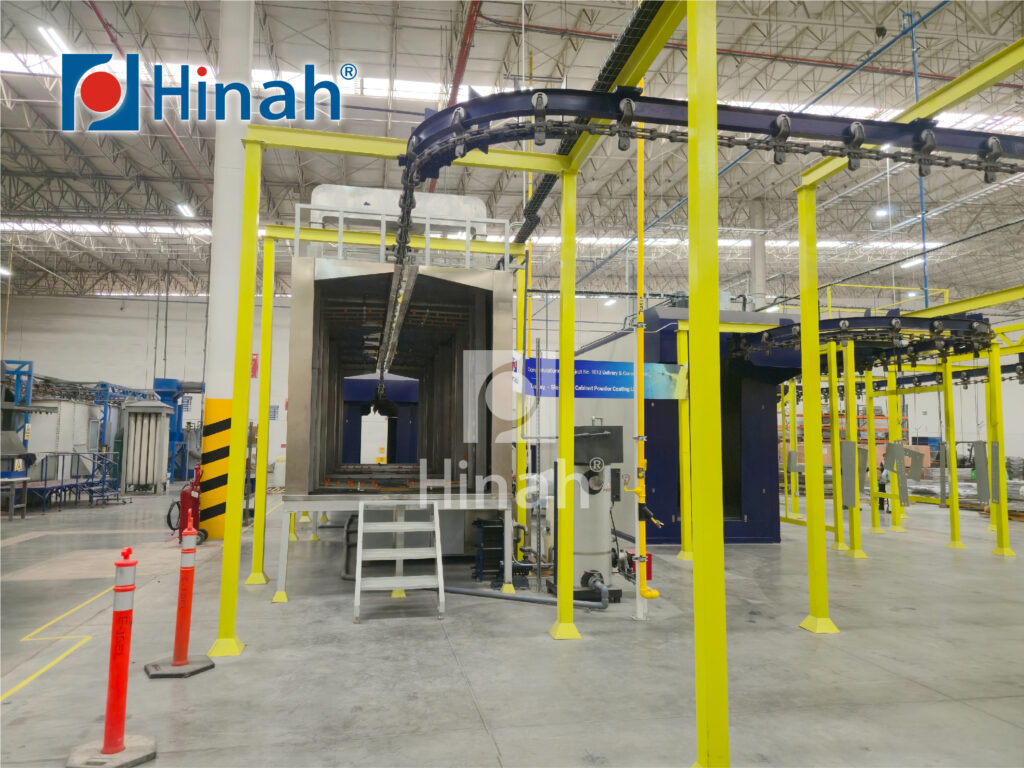
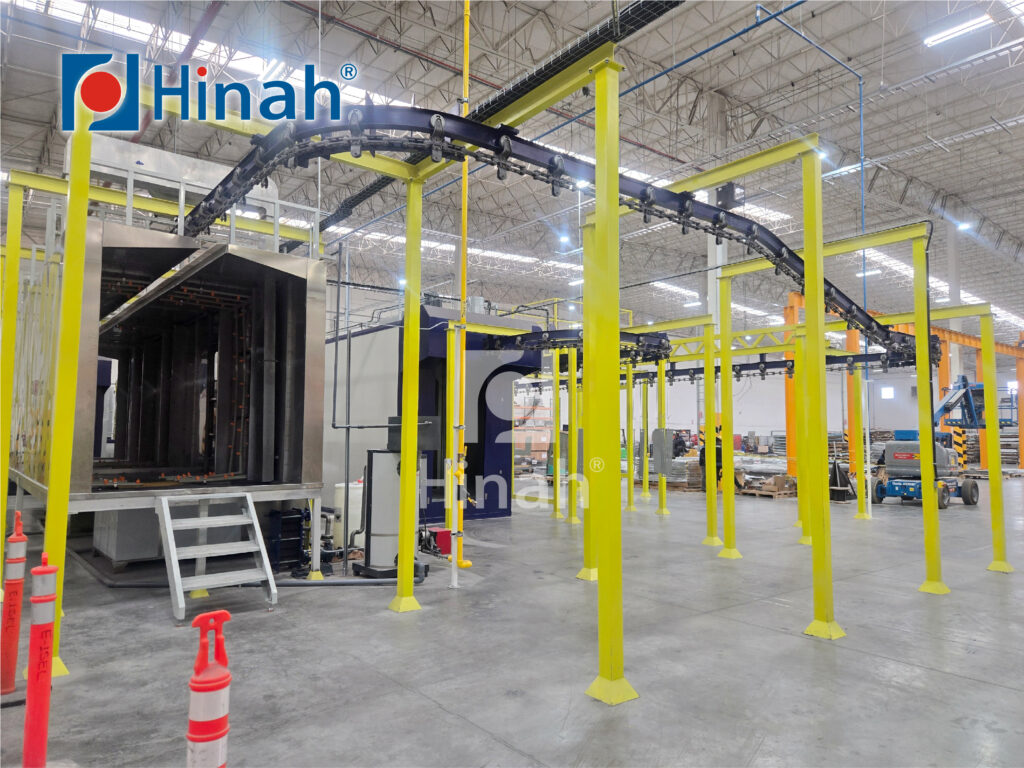
Degreasing: temperature, chemistry and the clock
A powder coating pretreatment process typically runs alkaline degreasers at pH 9–12 and 45–60 °C. Those numbers are starting points from the chemical supplier, not a specification you can copy between lines. Check concentration by titration on a schedule, because a bath that looks soapy can be far below strength once the surfactants have been consumed by oil.
Contact time matters more than most operators expect. Doubling concentration to save two minutes usually costs more in rinse carry-over than it gains in cleaning. Spray impingement does part of the work: blocked nozzles, worn fan tips and fixtures that shadow one face of the part all show up later as one-sided adhesion loss.
The most expensive shortcut is burning oil off in the oven instead of washing it off. Carbonised oil is harder to remove than the original lubricant, and the parts go into the booth with a surface that no powder can wet properly.
Rinsing is where quiet failures live
In the powder coating pretreatment process, rinsing is dilution, and dilution only works when water leaves the tank as fast as contamination enters it. Cascade and counter-flow arrangements are the usual answer: fresh water enters at the last rinse and flows back toward the first, so each stage is dirtier than the one after it, which is exactly what you want.
A stagnant rinse tank with an occasional top-up is the opposite arrangement. It accumulates alkaline or phosphate carry-over until it is effectively a weak process bath, and the parts come out of it coated in the wrong chemistry. Conductivity is the cheapest instrument on the line and the one most often missing: a rising trend at the final rinse tells you contamination is building before defects appear. The wastewater carryover guide covers the water and chemical side of that.
For the final rinse before dry-off, many specifications call for demineralized water held below roughly 30 µS/cm. Treat that as a starting point and defer to your chemical supplier’s technical data sheet and your customer’s acceptance criteria, which may be tighter.
Soluble salts deserve a separate measurement rather than an assumption. The Bresle method in ISO 8502-6, with conductivity converted per ISO 8502-9, gives a number you can put in a specification and check again after a process change.
Conversion coating: iron phosphate, zinc phosphate, or none
Iron phosphate produces a thin amorphous layer, typically 0.3–1.0 g/m². It is fast, runs at lower sludge levels and suits parts painted for indoor or mild-service use. Zinc phosphate builds a heavier crystalline layer, typically 1.5–3.0 g/m², gives more corrosion protection and more sludge, and needs tighter control of free acid, total acid and iron content.
Chrome-free systems based on zirconium or titanium have taken over a lot of lines for a practical reason: lower operating temperature, far less sludge, and wastewater that is easier to treat. They are less forgiving of a poorly cleaned surface, which is the trade-off worth understanding before switching. We cover that decision separately in our article on why a powder coating line switches to chrome-free pretreatment, and the wider cost case sits in whether it is time to replace traditional pretreatment.
What changes for aluminum and galvanized parts
Aluminum is not steel with a different label. Strongly alkaline degreasers attack the metal, and aluminum needs its own conversion chemistry, usually a chrome-free passivation rather than a phosphate. Running aluminum through a steel line without changing chemistry produces the diffuse, low-adhesion failure that gets misdiagnosed as a powder problem. For aluminum lines, the water balance is the other constraint: zero wastewater treatment on an aluminum powder coating line sets it out.
Galvanized parts add zinc to the equation: a reactive surface, white rust if the rinse or dry-off is slow, and a conversion layer that matches the zinc rather than the steel beneath it. ASTM D6386 describes the preparation practice; the pretreatment stages in front of the booth still have to be right.
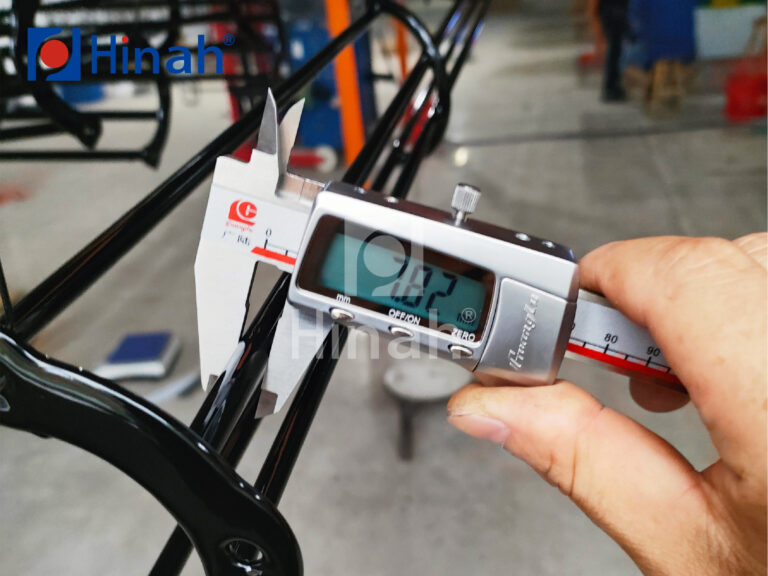
What matters in the powder coating pretreatment process is coating weight, measured and logged, not the color of the part. A phosphate layer that looks uniform can still be underweight on the shadowed side of a complex part.
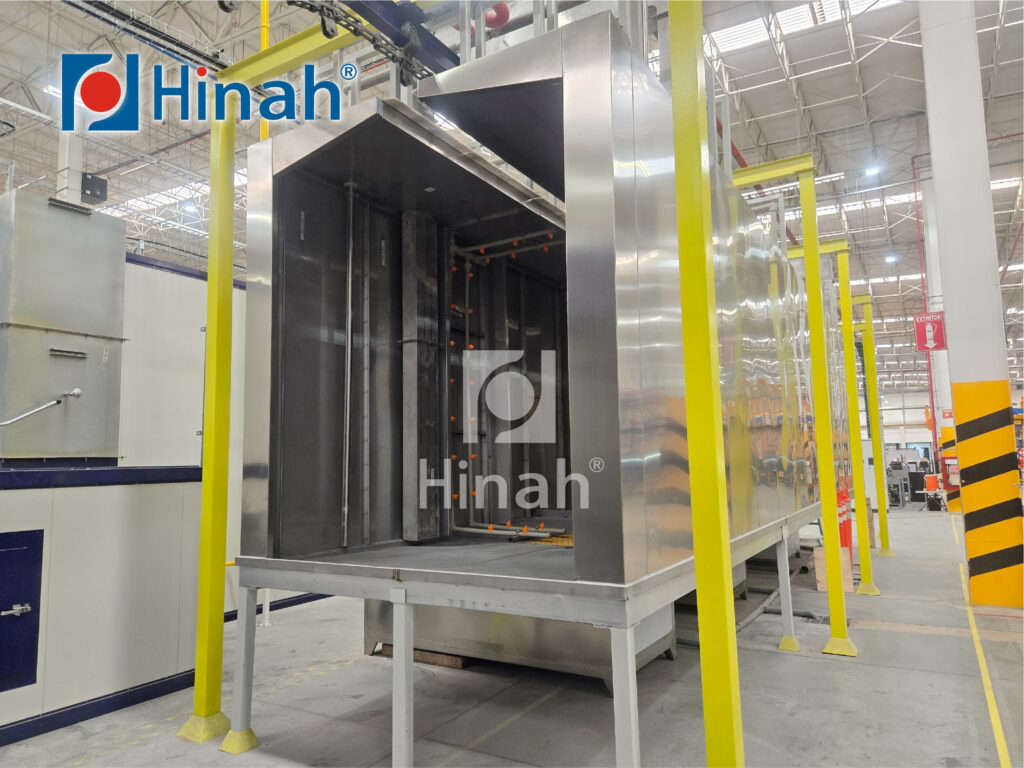
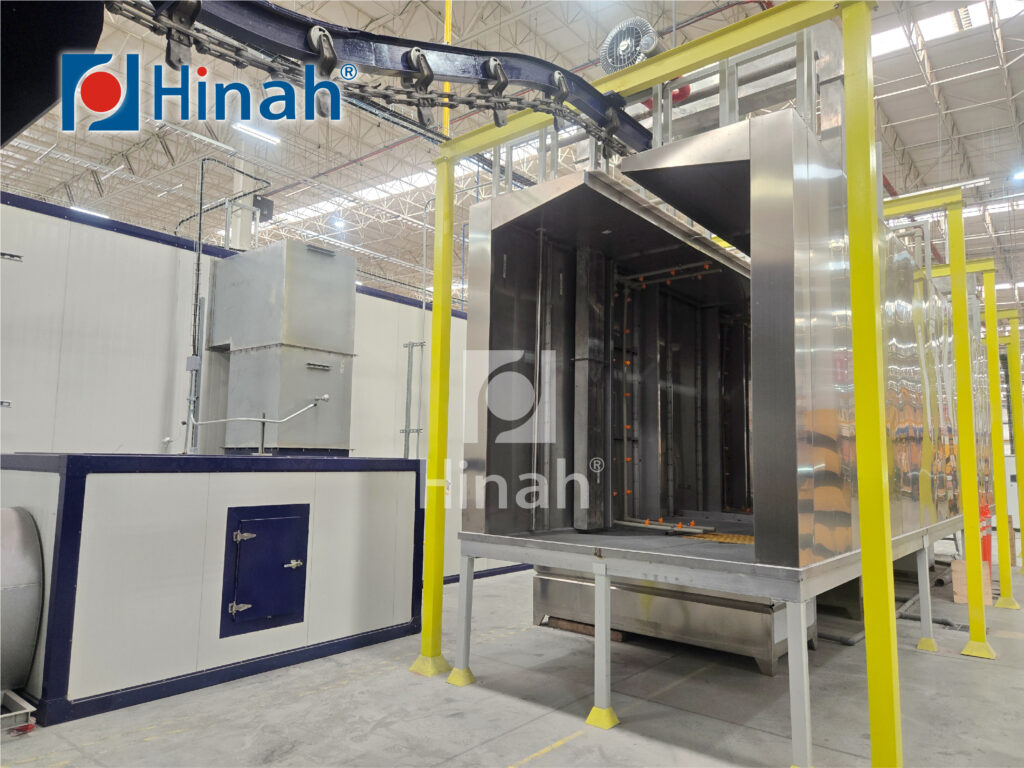
Dry-off does more damage than it gets credit for
Dry-off is the stage of the powder coating pretreatment process that gets the least attention. Water left in seams, folded edges and blind holes does not disappear politely. In the curing oven it boils, pushes through the powder film, and leaves pinholes that show up as rust points months later. The fix is usually mechanical: an air knife, a change of part orientation on the jig, or a longer drain before the dry-off tunnel.
The opposite mistake is over-drying. Zinc phosphate layers dehydrate and can crack when operators push the dry-off temperature up to keep pace with line speed, and the powder then bonds to a fractured layer. Size dry-off to the part, not to the conveyor. When the symptoms overlap with chemistry drift, is your pre-treatment killing your powder coating line sorts the two apart.
How to tell which stage failed
Start from the defect and work backwards through the powder coating pretreatment process. The table below is the order we use before touching gun settings.
| Symptom | First place to look | Check |
|---|---|---|
| Film lifts in sheets, entire part | Oil still on the surface | Water-break test, solvent rub on an off-cut |
| Peels at edges, burrs and weld spatter | Conversion layer too thin or damaged | Coating weight on a sample, cross-cut per ISO 2409 |
| Blisters under salt spray, adhesion still good | Soluble salts or moisture | Bresle per ISO 8502-6/-9, section the blister |
| Pinholes clustered at seams and welds | Water trapped in dry-off | Cut through the film, look for rust in the seam |
| Red rust along the scribe in salt spray | Coating weight or system thickness too low | Compare with the corrosivity category in ISO 12944-5, then check film build |
| Patchy, uneven conversion color | Bath contamination or poor impingement | Iron content, sludge, nozzle pattern |
| Adhesion good at 24 h, fails at 7 days | Residual chemistry reacting slowly | Final rinse conductivity, salt test |
Pull-off testing per ISO 4624 and salt spray per ISO 9227 are the two measurements worth putting in a routine. Both are slow, which is why they get skipped, and both tell you which stage to open up. If the defect is already on the parts, the inspection sequence in how to check for pretreatment defects turns this table into a walk down the line.
When the answer is equipment, not chemistry
Changing chemicals will not solve some powder coating pretreatment process problems. If the line has one rinse where it needs two, if drain times are shorter than the jig design allows, or if the dry-off tunnel suits a slower conveyor than the one you run, no additive will close the gap.
The stage count is the first thing to check when a line cannot hold quality at rate. A three-stage spray washer can be perfectly adequate for indoor steel work and completely inadequate for galvanized parts heading outdoors. The honest answer is sometimes that the pretreatment section needs another stage, not a stronger chemical.
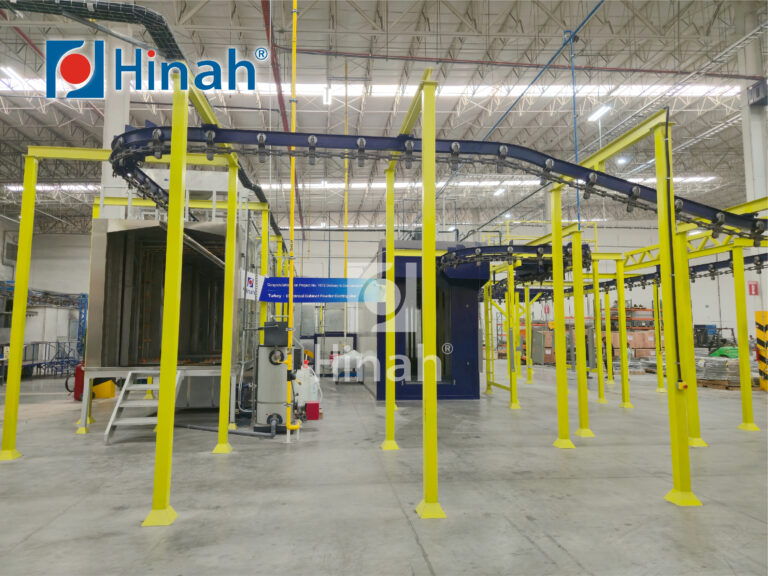
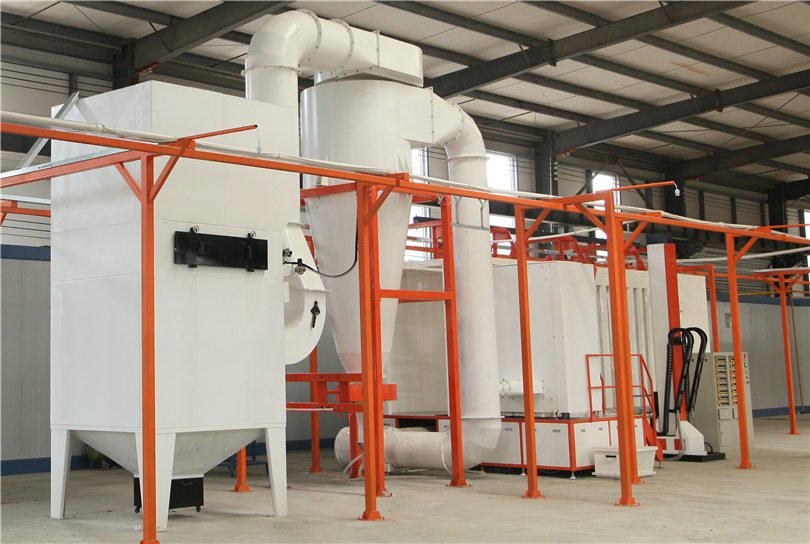
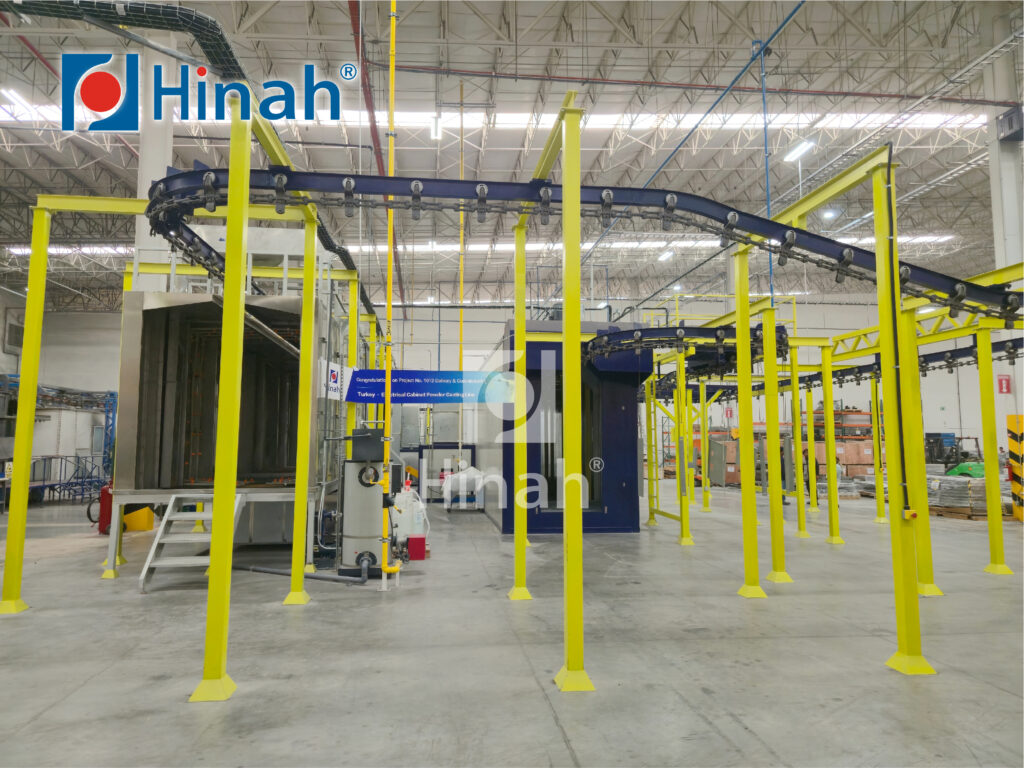
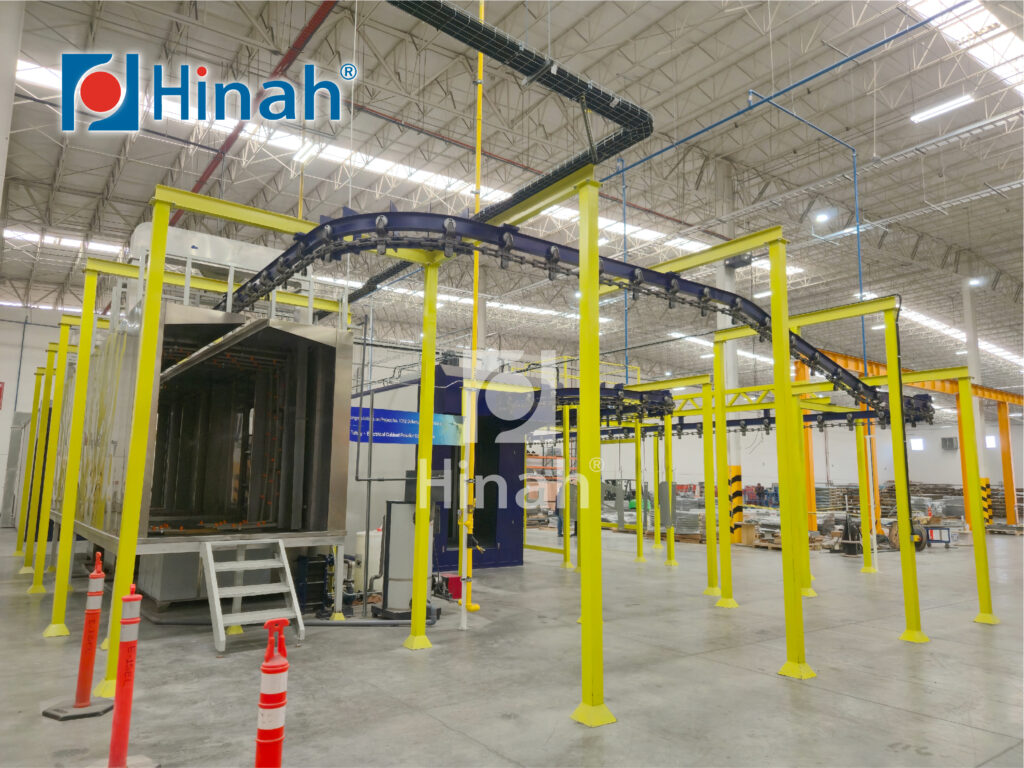
That is also where the layout argument starts: pretreatment is usually the longest section of a powder coating line per meter of conveyor, and it is the section most often compressed when floor space is short. We build the pretreatment section as part of the line, sized to the parts and the throughput rather than to the available floor. The powder coating pretreatment system page sets out the equipment options.
What to put in a pretreatment specification
A powder coating pretreatment process specification must read like a process sheet rather than a list of tanks. If you are buying a line, or accepting one, write it stage by stage: name the function, the control range, the instrument, and the test that proves the stage is doing its job.
| Item | What to specify | How it is verified |
|---|---|---|
| Stage sequence | Number and order of stages, spray or dip per stage | P&ID and as-built drawing |
| Bath volume and turnover | Tank volume, overflow rate, cascade direction | Flow meter reading at acceptance |
| Temperature | Operating range per stage, heating method | Logged during a full shift |
| Chemistry | Free alkalinity or concentration range, pH range for conversion | Titration and pH meter, daily |
| Rinse quality | Conductivity limit at final rinse | Inline conductivity meter, trend chart |
| Coating weight | Target range per substrate, per ISO 9717 classification | Strip-and-weigh or XRF on coupons |
| Dry-off | Air temperature, dwell time at rated line speed | Thermocouple survey on a production part |
| Adhesion and corrosion | Cross-cut and pull-off acceptance, salt spray hours | ISO 2409, ISO 4624, ISO 9227 |
A supplier who can hand over this table, with measured values from your parts, is telling you something different from one who hands over a brochure. It is also the only way to argue about a failure six months later without guessing.
The short version
The powder coating pretreatment process is not a washing step before the real one. It decides what the powder can do. Get the sequence, the rinse quality and the conversion weight right, and ordinary powder performs; get them wrong, and the best powder on the market fails in the same place.
If you are troubleshooting an existing line, start with the water-break test and the conductivity trend — both take minutes and both point at a stage. If you are specifying a new line, ask for the stage table with setpoints and acceptance tests, and compare that against the parts you actually run.
Send us your part drawing, substrate and target corrosivity category, and we will tell you which pretreatment stages the line needs and what the acceptance tests should be.
Sources
ISO 12944-4 — surface types and surface preparation for protective paint systems.
ISO 9717 — phosphate conversion coatings on metals, including coating weight classification.
The Bresle method for soluble salts and conductivity conversion sits in ISO 8502-6 and ISO 8502-9.
ASTM D6386 — preparation of hot-dip galvanized surfaces for painting.
ISO 2409, ISO 4624 and ISO 9227 — cross-cut, pull-off and neutral salt spray tests.