
Fading that appears a year after delivery rarely starts with the powder. In most cases a powder coating line leaves the resin under-cured, the film too thin, or the pretreatment incomplete. The colour loss shows up months later, when the parts already sit on a building. You can trace the real cause in one afternoon.
How Do I Tell Fading Apart From Chalking and Gloss Loss?
People use the word “fading” for three different problems, and each one points to a different fix.
- Colour shift means the pigment itself changed. Measure it as ΔE on a spectrophotometer, following ASTM D2244.
- Chalking leaves a fine powder on your hand when you wipe the surface. The resin broke down and released pigment that no longer sits inside the film.
- Gloss loss shows on a gloss meter as a drop in units, measured to ASTM D523.
A part can chalk and lose gloss while the colour barely moves. A customer will still call all three of them fading. Record every number before you change any setting, because that baseline decides later whether your fix worked. Without a baseline you argue from memory, and memory favours whoever talks loudest. Take your readings on the same spot each time, since flat faces and cut edges age at very different rates.
Why Does Under-Curing Drive Most Outdoor Fading?
Powder cures by peak metal temperature, or PMT. It does not cure by the air temperature on the oven display.
A thick extrusion or a heavy weldment heats slowly, so the oven reaches setpoint while the metal still sits 10–20 °C below the cure window. Resin that never fully cross-links keeps a weak backbone, and sunlight breaks that backbone down fast. Chalking and dull colour then appear within one season.
Check PMT on your powder coating line with a data logger taped to a real production part. Do not trust the air probe, because air reads hotter than metal every time. Part mix changes the answer too, so test a heavy part and a light one in the same run. Log the oven profile across a full shift, so a drop in heat input shows up early.
Over-curing hurts as well. Run the metal too hot and the resin degrades before the part leaves the oven.
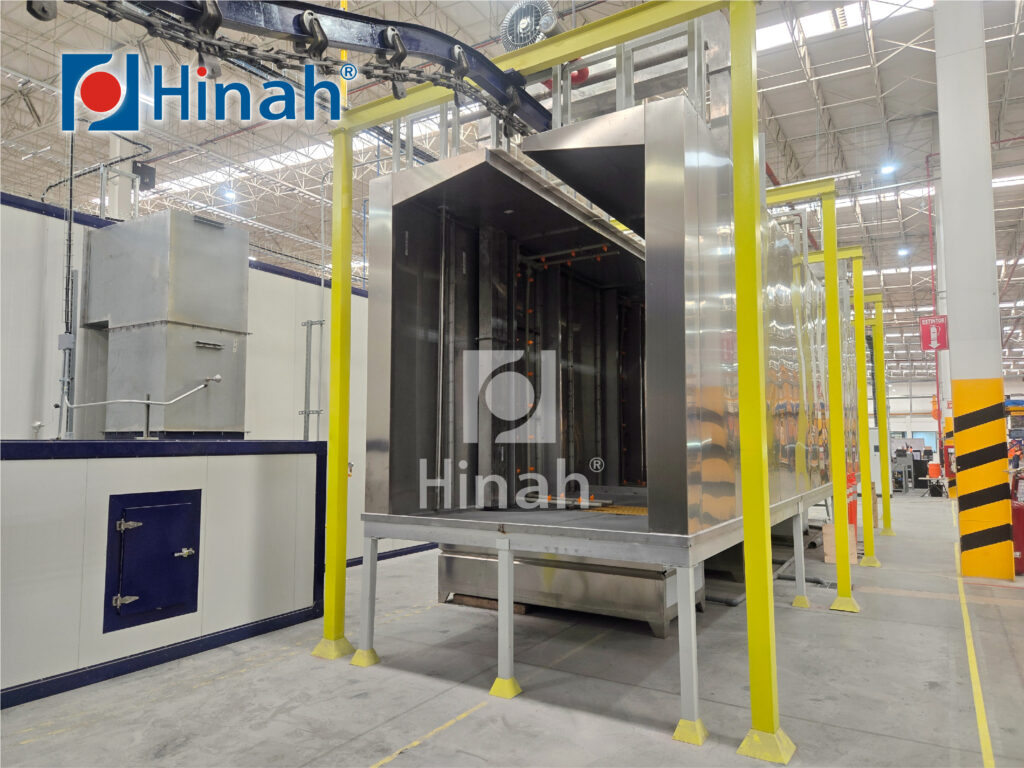
Can Pretreatment on My Powder Coating Line Cause Fading?
Yes, and it is the cause most people skip. A weak conversion coating lets the film lose grip along edges and around fixing holes. Moisture creeps under the coating, so the film lifts in small patches. Sun and rain then attack the exposed spots, and the damage spreads with each weather cycle.
Two conditions matter most.
- Rinse water after the conversion stage. High conductivity leaves salts on the surface. Those salts pull moisture into the interface and start the failure. Check conductivity daily, because a tired rinse bath drifts without warning. Test the last rinse stage rather than the tank behind it, and test twice a shift on humid days.
- Coating weight. Stay inside the supplier’s window. Too light gives poor protection. Too heavy gives a brittle layer that cracks when the part flexes.
Walk your powder coating line and check both before you blame the powder. Both checks take ten minutes.
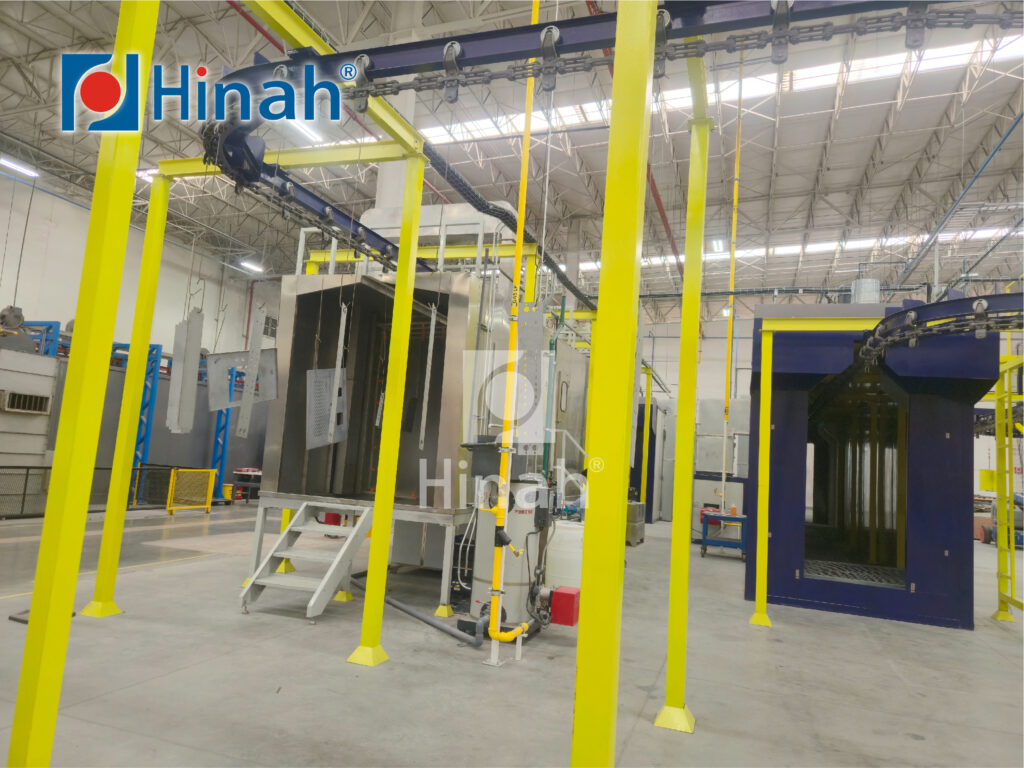
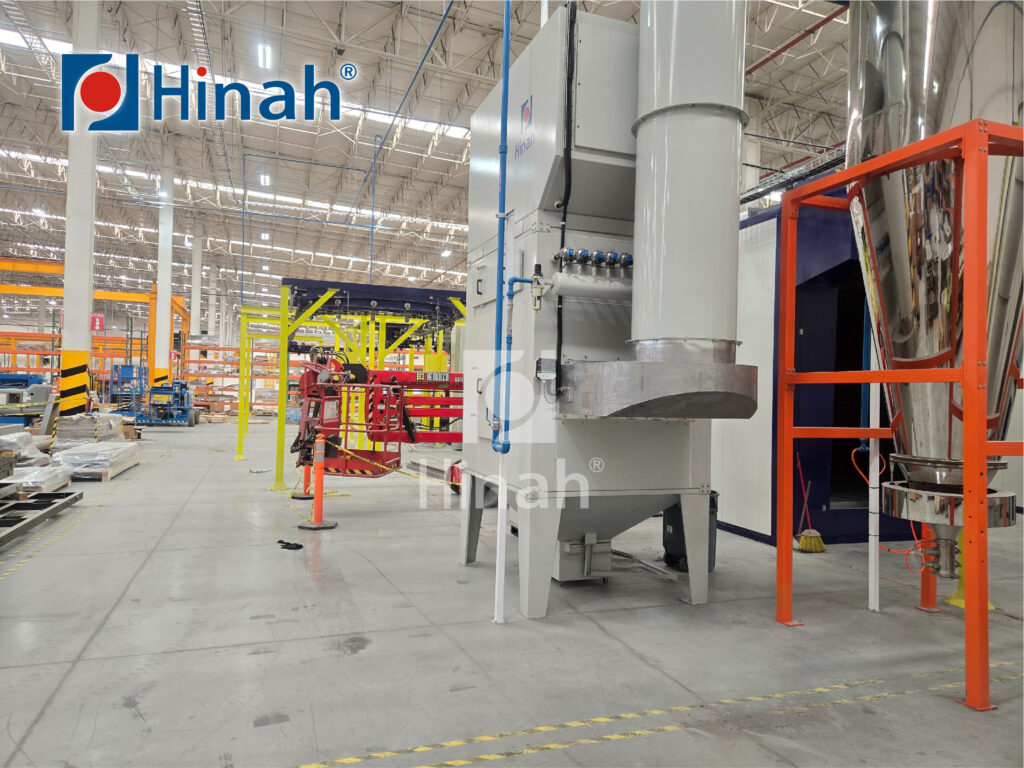
What Should I Change on My Powder Coating Line?
Chemistry sets the ceiling for outdoor life on a powder coating line, and film build decides how long that chemistry lasts.
Which Powder Chemistry Holds Colour Outdoors?
Polyester handles outdoor exposure well and covers most industrial work. Superdurable polyester resists chalking and gloss loss far longer, so it suits strong sun and coastal air. Epoxy and hybrid powders chalk quickly in sunlight, so keep them indoors. Match the grade to the exposure class. QUALICOAT classes and AAMA 2603, 2604 and 2605 define those performance levels for architectural aluminium.
How Thin Is Too Thin on Film Build?
Most architectural specifications call for 60–80 µm. Below 60 µm, UV reaches the pigment sooner, so thin edges fail first. Measure on the part itself, not on the rack, because rack readings flatter the real number.
How Do I Prove the Fix?
Run a controlled comparison instead of arguing from opinion.
- Keep panels from the old setting.
- Change one variable: the cure window, the film build, or the rinse water.
- Send both sets to accelerated weathering to ISO 16474-2 under a xenon-arc lamp.
- Track ΔE and gloss retention for both sets on the same schedule.
The numbers then show which change worked. Log PMT, film build and rinse conductivity every shift, so a drift appears as data instead of as a complaint.
Fading is a slow failure, so it rewards slow and measured work. Fix the cure window first, then film build, then pretreatment chemistry. A powder coating line that holds its cure window will hold its colour, and the warranty claims will stop. Send us your oven profile for a second opinion.