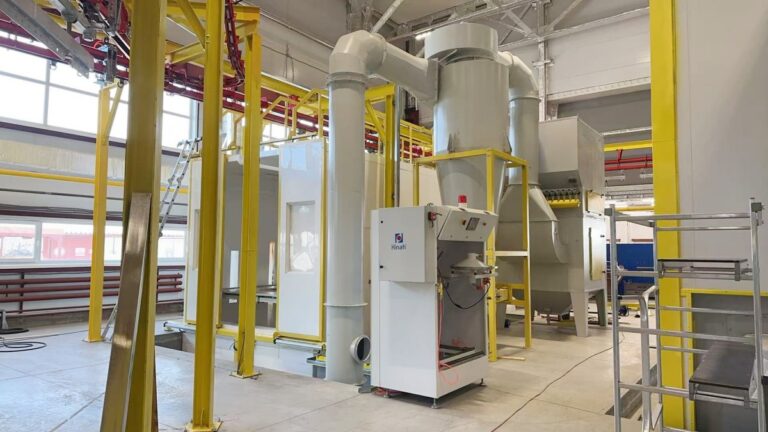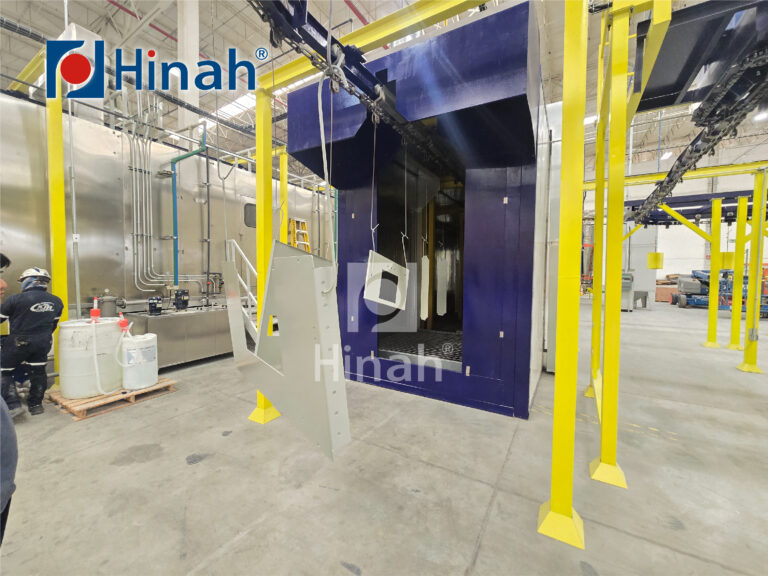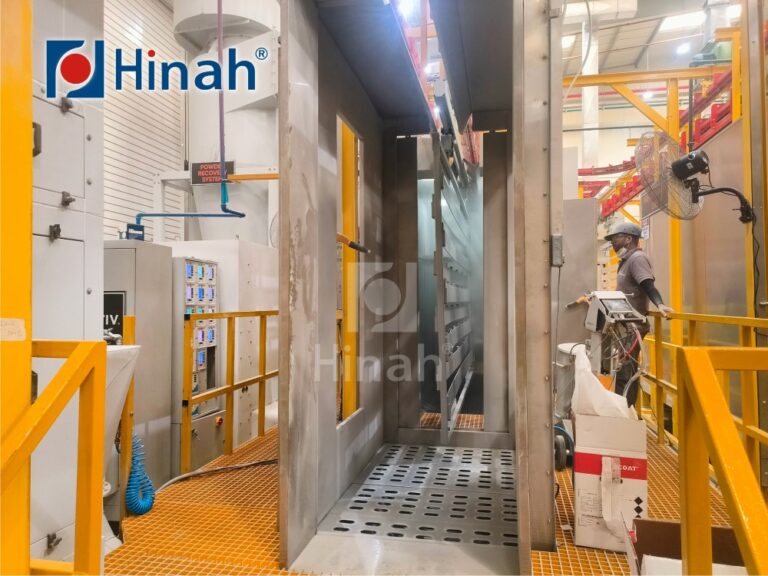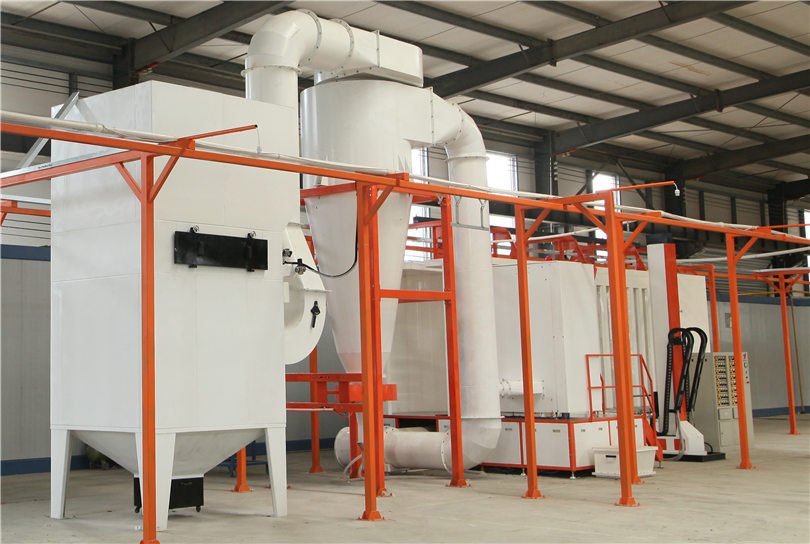

No, not by spraying alone. A powder coating plant coats the outside of a transformer tank very well, yet it cannot coat the inside. Powder rides an electrostatic charge toward the nearest grounded surface the gun can see. A sealed tank blocks that line from every direction. So the real question is which surfaces your customer’s specification judges. That answer decides whether you need a second process behind the booth.
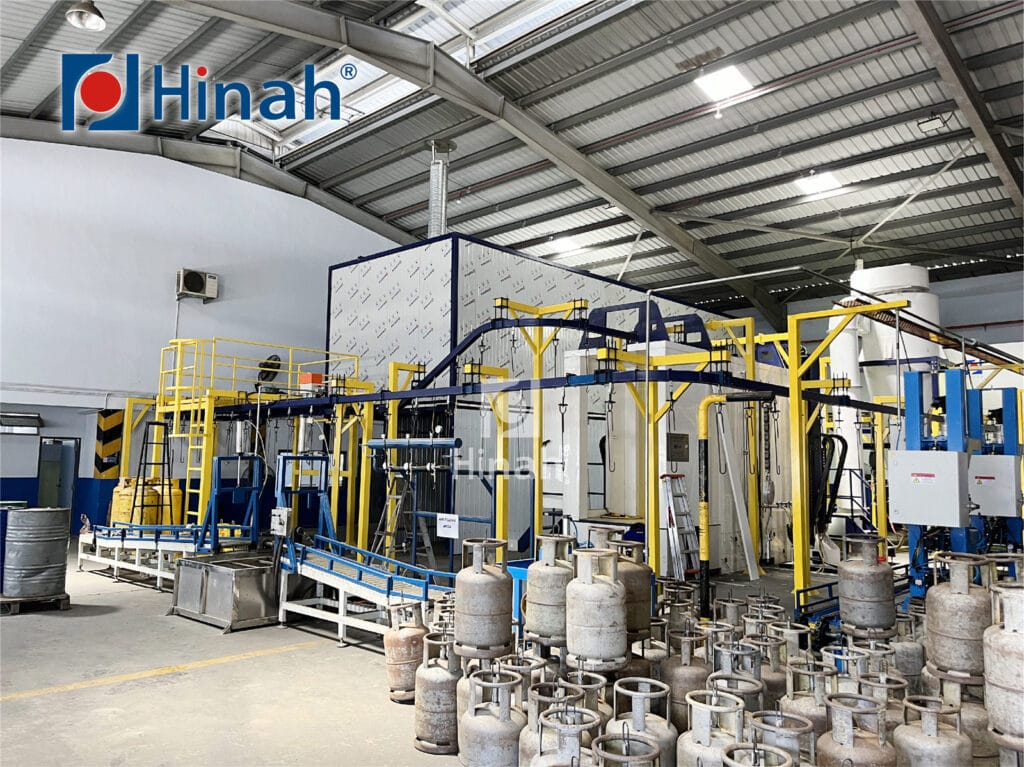
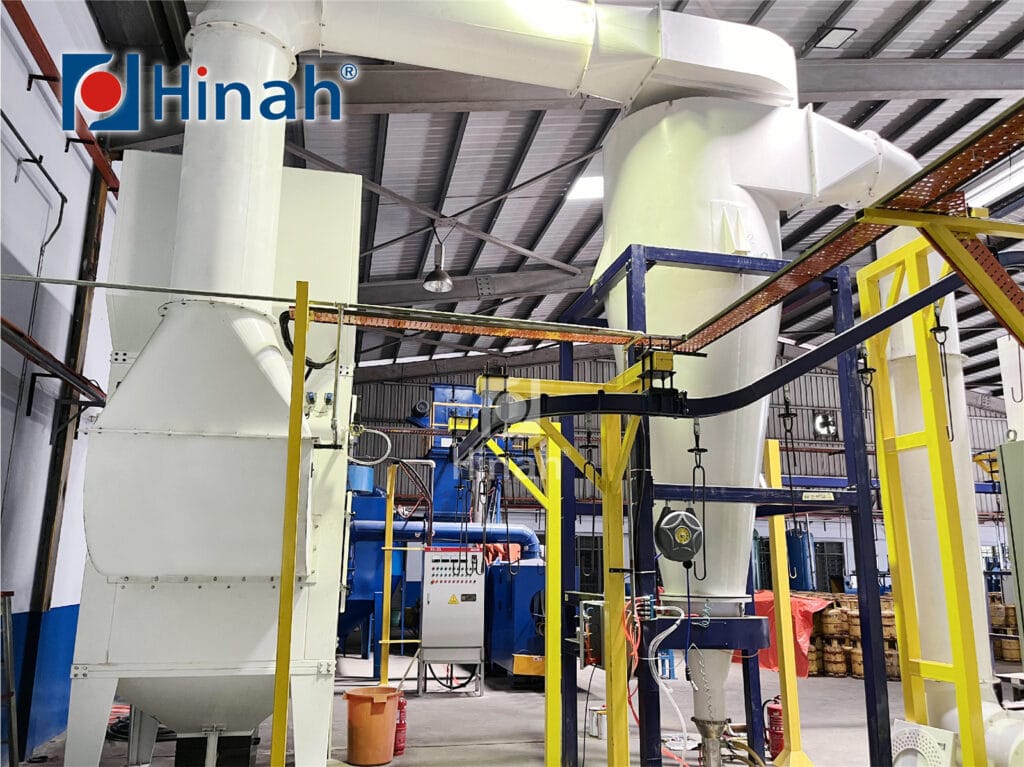
Why Powder Cannot Reach a Tank Interior?
Three things stop the spray.
- First, a gun must see a surface before powder can land on it. The interior sits behind walls, so the far corners stay invisible from every gun position.
- Second, the joint between a stiffener rib and the tank wall forms a deep pocket. That pocket shields itself, so the guns cannot wrap powder into it.
- Third, a closed tank behaves like a Faraday cage. The grounded steel pulls the charge to the nearest surface, and recessed faces starve.
Manual touch-up fixes an open cabinet or a channel section, because an operator can point a gun at those faces. Nobody stands inside a welded tank. Thicker powder does not solve it either. A heavier film on a visible wall changes nothing about a wall the gun never sees. An operator who sprays into the tank opening coats the first wall and misses the rest. That effort spends powder and leaves an uneven film.
A partial interior film can even make things worse. It hides bare steel from inspection, and corrosion then starts at the thin edges where the film runs out. So I treat the tank interior as a separate coating job, not as an extension of the exterior pass.
What the Interior Film Has to Survive?
The inside of a transformer tank works harder than the outside in one way. It sits above insulating oil for the whole service life. So the film must resist oil. It also must not release anything into the oil that changes dielectric behaviour. That requirement belongs to the coating supplier, so I ask for the evidence in writing before I commit a tank interior to any film.
Condensation is the second load. Day and night temperature swings push moisture into rib pockets, and a coastal site adds chloride. The corrosion category in your project specification sets both the film thickness and the acceptance test. ISO 12944 places coastal and heavily polluted sites in C4 and C5. Inland industrial air sits at C3.
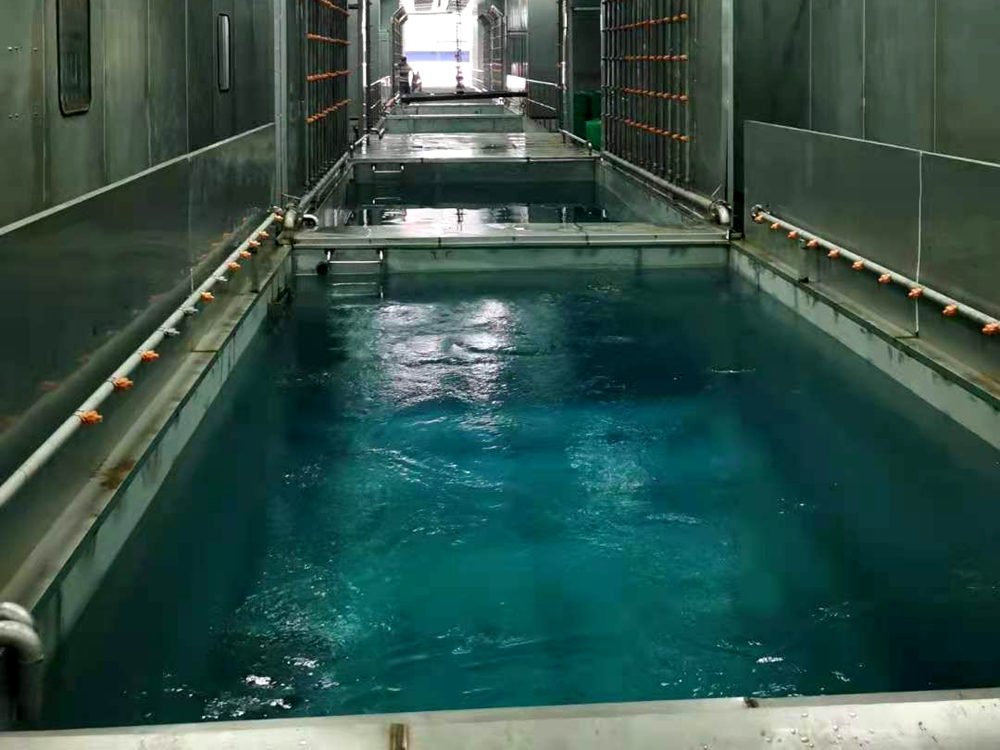
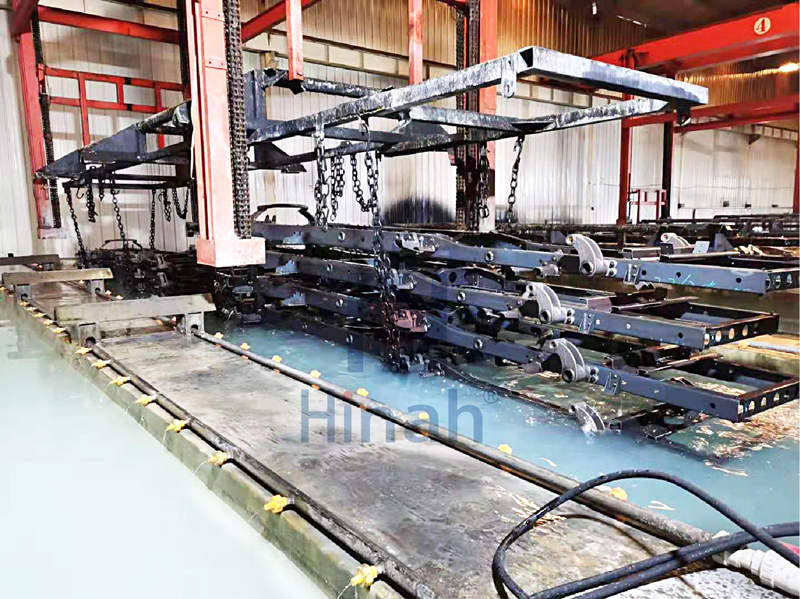
Cathodic electrocoating handles this geometry. An electric field drives resin into internal surfaces and rib pockets. The bath then deposits a uniform film of roughly 20 to 25 µm inside and out. Baked epoxy at that thickness protects the steel through storage, transport and service. Powder cannot copy that result, because the process depends on line of sight rather than on an electric field.
Both processes then cure in the same 170 to 200 °C band. So the oven, not the chemistry, sets the cycle time on a heavy tank.
Where Powder Coating Plant Still Wins?
Powder keeps the exterior, and it earns that job. One pass lays down 60 to 100 µm, so a large flat tank wall reaches heavy-duty film thickness without a second trip through the line. Exterior-grade polyester resists chalking and colour shift under Gulf sunlight. A thin electrocoat primer does not. Colour comes from the booth as well. The same line can run a dark grey tank in the morning and light switchgear grey in the afternoon.
Cost favours powder too. A powder line runs without an electrodeposition bath, an ultrafiltration loop or a deionised rinse train. So capital cost and process control stay simpler than a standalone e-coat line.
Most coastal C4 and C5 projects therefore land on a duplex system. Electrocoat carries the corrosion duty as the primer. Powder carries colour, gloss and UV stability as the topcoat.
Throughput then shapes the rest. A plant running a few large tanks a day absorbs racking and cure time. A plant running hundreds of identical distribution tanks a week prefers the steady rhythm of a bath.
Then I prove the system on the production part, not on a flat panel. I run adhesion to ASTM D3359. I expose the part to salt spray to ASTM B117, and I rate the scribe creep with ASTM D1654. Where the site cycles between wet and dry, I add a condensation test to ISO 6270-2. I measure film thickness to ISO 2178, and I log it on the flat face, the rib and the weld. I mask earth pads, nameplate areas and machined flange faces, and I keep them bare. A film that creeps onto an earth pad costs the customer a return visit.
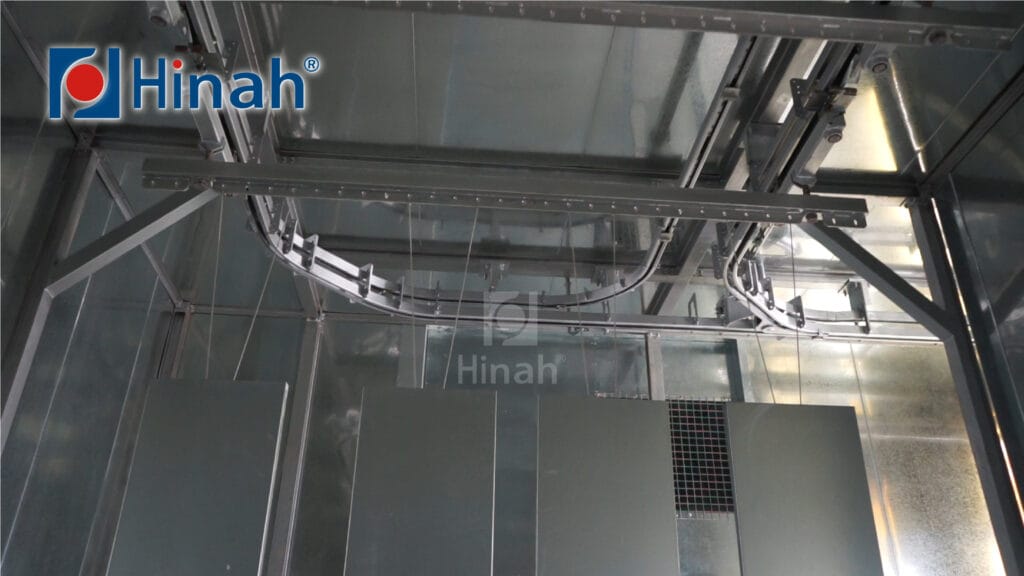
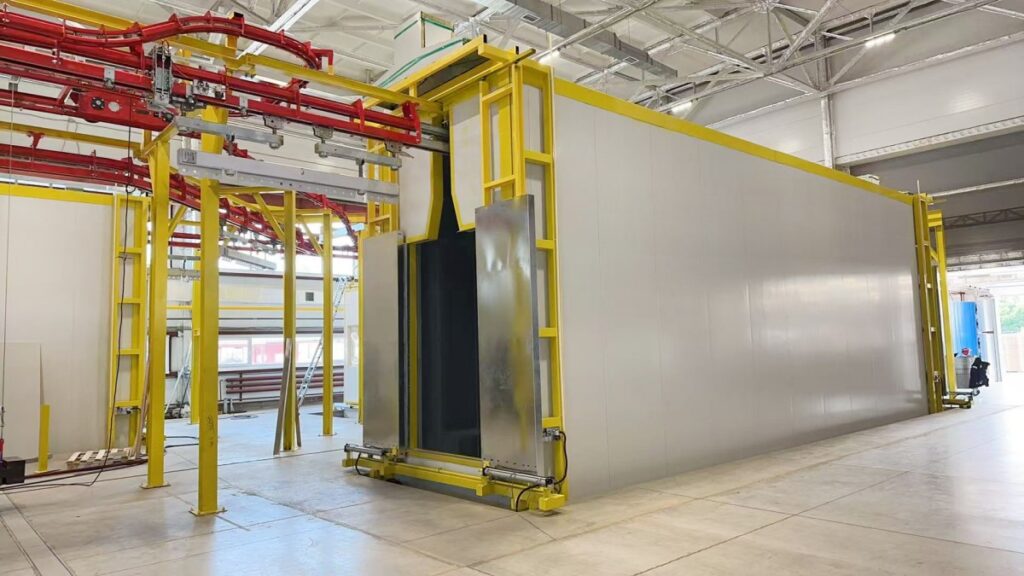
So a powder coating plant covers the tank exterior and the visible faces. The interior needs a dip or electrocoat stage beside it. Send me the part mass, the corrosion category and the surfaces your customer inspects, and the process route follows from those three inputs.