
Paint sagging is one of the most frustrating defects in industrial spray painting. It appears as a downward flow, run, or thickened area on a vertical or inclined surface. In a liquid coating line, the problem usually starts when the wet film cannot resist gravity long enough to hold its shape. Film thickness, coating rheology, spray application, and drying conditions all play a role.
ISO 16862:2003 is specifically designed to evaluate sag resistance in liquid coatings. It includes a spray-gun method in which the coating is applied to a vertical substrate, directly connecting the test method with spray application.
What Causes Paint Sagging?
Paint sagging occurs when the applied wet film flows downward before it develops enough structure to stay in place. Gravity drives the movement, but the coating’s flow behavior determines how easily that movement occurs.
A study published in Progress in Organic Coatings found that sagging in paints is mainly governed by rheology. The research used rheological measurements to predict sag resistance and linked the results to the Anti-Sag Index defined by ASTM D4400.
In production, this means that a coating with unsuitable flow behavior can sag even when the spray equipment appears to work normally.

Why Does Film Thickness Matter in a Liquid Coating Line?
Wet film thickness is one of the first things to check when sagging appears. A thicker wet film places more material on the surface, giving gravity more opportunity to pull the coating downward.
However, simply reducing film thickness is not the answer. The coating still needs to meet its specified thickness and provide the required coverage and protection.
The goal is consistency. Spray gun distance, gun movement, paint flow, and overlap all affect how much coating reaches the surface.
How Does Coating Rheology Affect Sagging?
Rheology describes how a coating flows and deforms. It becomes especially important when a wet film remains on a vertical surface.
The 2021 research on sag resistance found a strong relationship between rheological behavior and the Anti-Sag Index. This is why viscosity alone does not always tell the whole story. Two coatings can have similar viscosity under one test condition but behave differently during spraying and leveling.
For production, follow the coating supplier’s specified viscosity and application conditions, then monitor actual spraying performance.
Why Are Vertical Surfaces More Prone to Sagging?
The reason is simple: gravity acts directly along the surface.
On a vertical surface, gravity continuously pulls the wet coating downward. Large panels, cabinet sides, frames, pipes, and steel structures can therefore be more sensitive to excessive wet film thickness.
ISO 16862 evaluates coatings in a vertical position to measure their resistance to sagging. The standard applies specifically to liquid coatings.

Can Spray Application Affect Paint Sagging?
Yes. A coating line can create different wet film conditions even when it uses the same paint.
Inconsistent spray distance or gun movement can change how much coating reaches one area. Poor overlap can create local thickness differences as well. If several passes build up too much material in one location, sagging becomes more likely.
In automated systems, a stable spray path and repeatable workpiece movement help keep conditions consistent.
ISO 28199-3:2021 provides methods for assessing sagging and other coating defects after spray application under defined conditions. The standard includes both visual assessment and measurement techniques.
How Can a Liquid Coating Line Reduce Paint Sagging?
The best approach is to check the complete process instead of changing one parameter blindly.
Start with the coating material. Confirm that its viscosity, mixing condition, and application temperature match the technical requirements.
Then check the spraying process:
- Is the spray distance consistent?
- Is gun movement stable?
- Is paint flow within the specified range?
- Is the spray pattern uniform?
- Are overlapping passes creating excessive film thickness?
- Is conveyor speed stable?
Next, review flash-off and drying conditions. The coating also needs suitable conditions before the next stage.
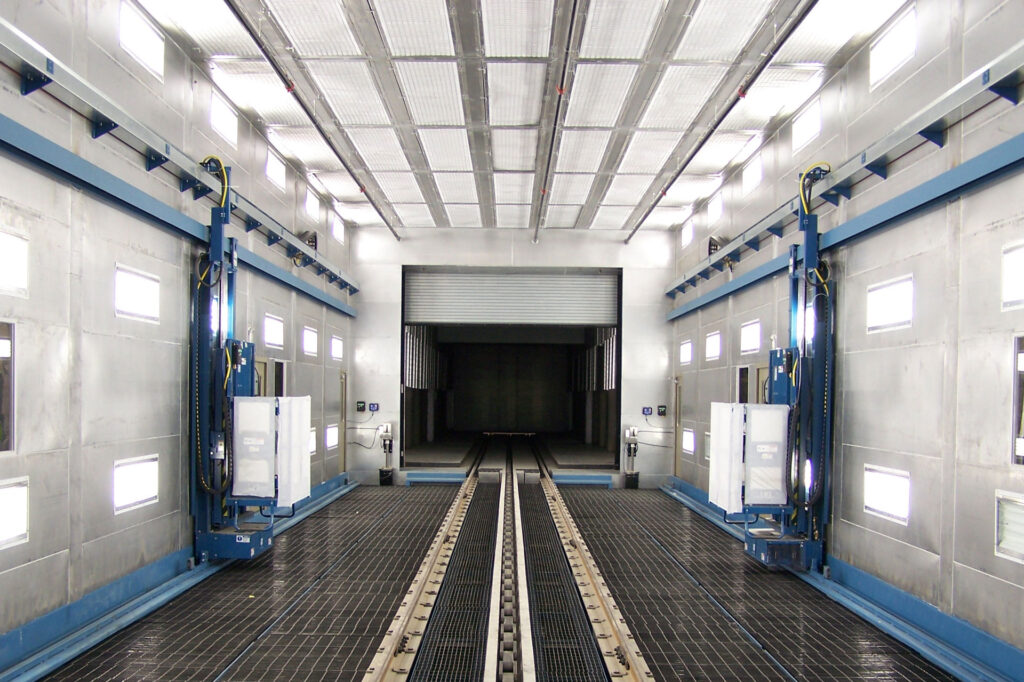
A well-designed liquid coating line should make these conditions easier to control through stable conveying, spraying, flash-off, and drying.
What Should You Check When Sagging Suddenly Appears?
When a line that normally produces good surfaces suddenly develops runs, avoid changing several parameters at once.
Check the process step by step:
- Measure film thickness.
- Check coating viscosity.
- Inspect spray gun distance and movement.
- Check paint flow and spray pattern.
- Review overlap between spray passes.
- Check conveyor speed.
- Review flash-off and drying conditions.
- Compare defective parts with previously accepted parts.
This makes it easier to separate a material issue from an application issue.
A Stable Process Is the Key to Preventing Sagging
Paint sagging is a balance between gravity, film thickness, coating rheology, and spray conditions. ISO 16862 provides a dedicated method for evaluating sag resistance in liquid coatings, while ISO 28199-3 addresses sagging assessment after spray application.
For industrial production, the goal is not simply to fix a defect after it appears. A properly configured liquid coating line should maintain consistent conveying, spraying, flash-off, and drying conditions. When these factors remain stable, the wet film has a better chance of staying uniform.
When sagging occurs, look at the entire process rather than one machine setting. That approach supports more consistent coating quality and a more stable liquid coating line.