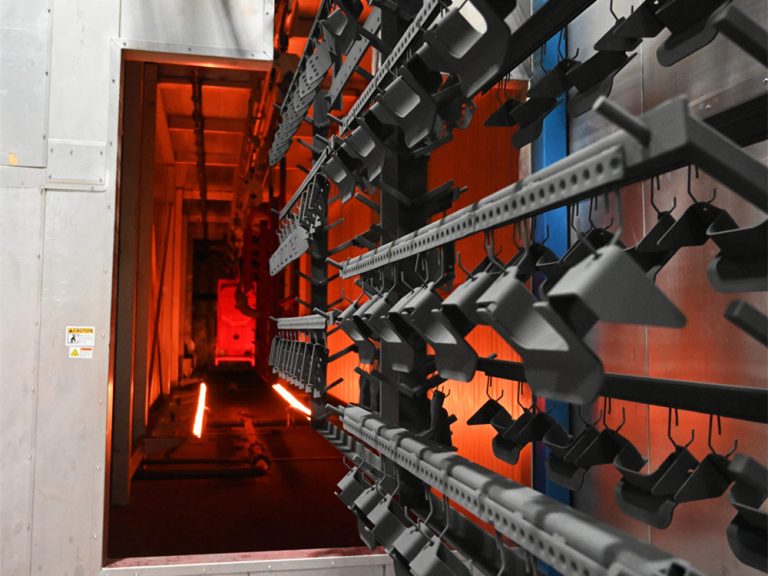

A thick steel bracket leaves the oven looking fully cured. Four days later the film chips off a weld and the batch goes on hold. The powder coating oven temperature matched the datasheet, so the oven takes the blame. In most cases the oven is fine. The part never stayed hot long enough, and the cure check ran on a thin panel.
What Does Powder Coating Oven Temperature Actually Measure?
Most controllers read a probe near the ceiling or in the return duct. That number proves the air is hot. It says nothing about the steel. A 1.5 mm panel follows the air within minutes. A 10 mm flange or a dense hanger load can lag for half the dwell time.
| Reading | Source | What it proves |
|---|---|---|
| Powder coating oven temperature | Controller probe, ceiling or return duct | The air is hot, not the part |
| Surface temperature | Handheld IR gun, aimed at the face | The skin is warm, the core may lag |
| Metal temperature | Logger bolted to the thickest section | The cure clock has started |
Why Do Thick Parts Under-Cure at the Same Setpoint?
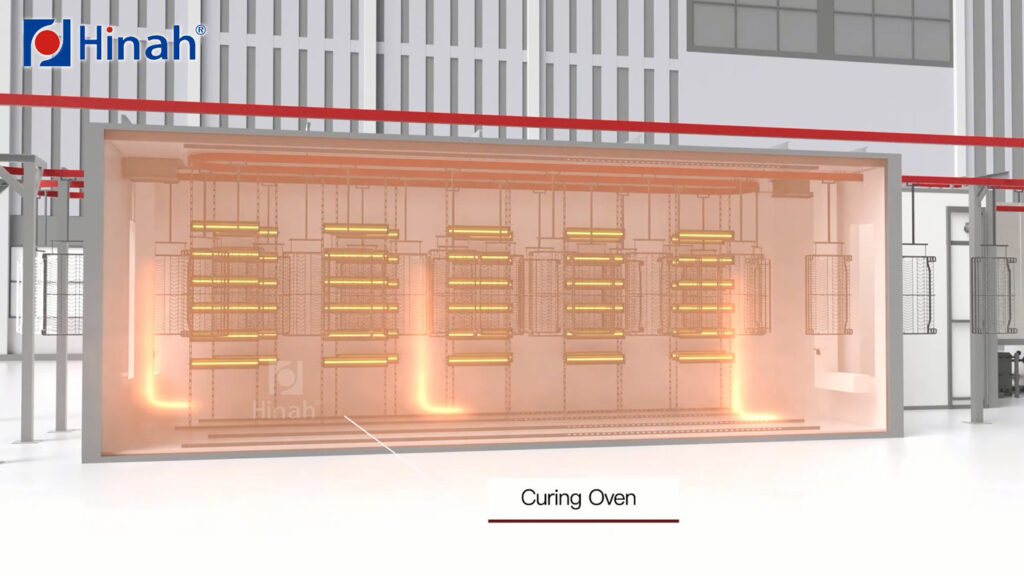
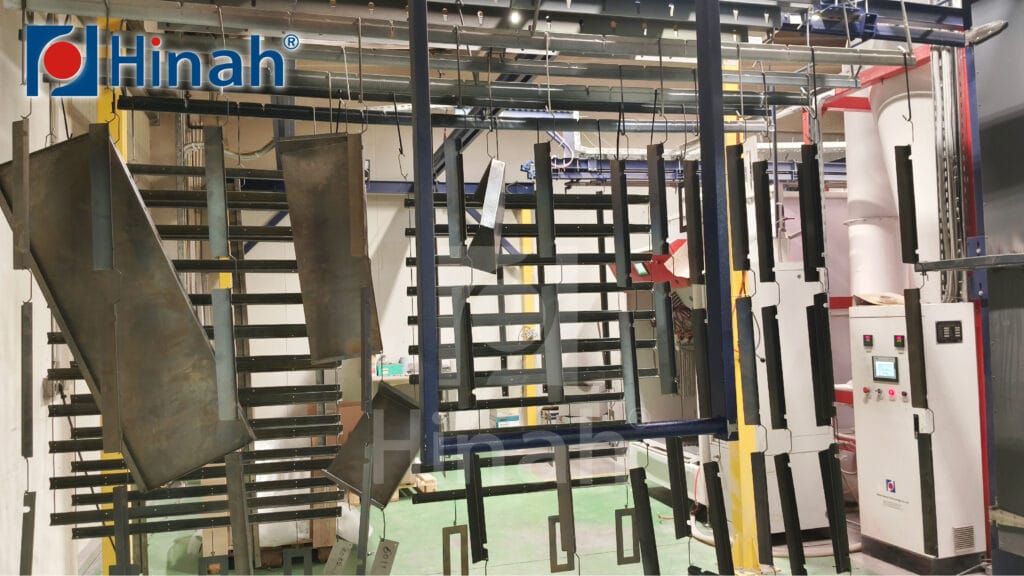
Cure needs three things at once: metal temperature, time above it, and the right film thickness. A correct powder coating oven temperature on the display still leaves the core cold. Section thickness sets how fast heat reaches the centre, and heat-up time grows roughly with the square of that thickness. A heavy casting warms slower than a thin panel on the same hook. Hang it behind another workpiece and it slows again, because radiant heat no longer reaches the face. Extra weight without extra dwell time is the same as a shorter oven.
How Do Oven Length and Line Speed Set the Real Cure Window?
Dwell time equals oven length divided by conveyor speed. A 40 m oven at 2 m/min gives 20 minutes inside, and that is the number people quote. It is not the cure time. Part of those minutes goes into heat-up. If a bracket needs eight minutes to reach metal temperature, twelve remain at temperature. Run it at 2.5 m/min and the total drops to sixteen, leaving eight. Under-cure starts here, and no alarm on the HMI will flag it. On an automatic powder coating line, line speed is a cure parameter, not a scheduling choice.
Why Doesn’t a Higher Setpoint Fix It?
Adding 20 °C feels cheap, and for some powders it works. Others punish it. Whites yellow, gloss drifts, and impact strength falls as the binder over-crosslinks. A part that passes a thumb test can still fail a bend test. If the line also runs thin-gauge work, that raised powder coating oven temperature over-cures the light parts while the heavy ones stay marginal. You end up with two defects instead of one. Zoning and burner capacity belong in the plan before choosing a curing oven.
How Do You Confirm Powder Coating Oven Temperature Reached the Core?
Measure the metal, not the air. Bolt a data logger to the thickest section in the heaviest load, then run a normal shift. The curve shows whether the powder coating oven temperature reached the core, and how long the part held it. A solvent rub to ASTM D5402 exposes under-cure in minutes. Impact testing to ASTM D2794 and a mandrel bend to ISO 1519 catch overbake. Gloss readings to ASTM D523 show it on light colours. For a formal cure window, gel time testing to ISO 8130-6 settles what the supplier specified. Industry training, including the Powder Coating Institute workshops, treats cure as a substrate event, not an oven-air event.
What Should You Change First?
Start with measurement, because every other fix depends on it. Then rebuild the recipe around metal temperature instead of the powder coating oven temperature on the screen. Set the first zone to heat rather than cure, and check that burner output recovers after a load enters. Slowing the conveyor by 10% often buys more cure than adding 10 °C, and it costs nothing. Then fix the mechanics: hanger spacing, part orientation, and hook loading. Only when all three are right does a longer oven pay off. The same logic applies when a line misses its rated output.
| Symptom | First check | Usual fix |
|---|---|---|
| Film chips at welds after a few days | Core curve, heaviest load | Slow the conveyor |
| Gloss drop or yellowing on white | Peak metal temperature against the TDS | Cut the setpoint for thin work |
| Solvent rub soft on thick sections | Heat-up time against section thickness | Add a heat-up zone |
Thick parts under-cure because the powder coating oven temperature describes the air, not the steel. Log the metal curve on your heaviest load, set dwell time from it, then confirm with a solvent rub and an impact test. Once those numbers are visible, the choice between a slower line, a re-zoned oven or a new unit becomes engineering, not guesswork. Our powder coating curing oven range covers single-zone and multi-zone designs for this reason.