
Many blame their powder coating guns or powder curing ovens when a coating fails. However, the root cause usually lies much earlier in the process. Your powder coating line depends entirely on the first few meters of the system: the pre-treatment stage. If this stage leaves behind microscopic oil, rust, or chemical salts, even the most expensive powder will peel or blister.
Think of pre-treatment as the foundation of a building. You cannot fix a weak foundation with a better roof.
The Symptoms of a Failing Pre-Treatment Process
Poor pre-treatment creates visible and invisible defects. You might see these issues immediately, or they might appear months later after the product reaches the customer. Recognizing these signs helps you identify exactly where your powder coating line is failing.
Interlayer Delamination
When the coating peels off in large flakes, you have an adhesion problem. This usually happens because a microscopic layer of oil or oxidation remains on the metal surface. The powder bonds to the contaminant instead of the substrate. During the curing process, the heat expands the trapped air or moisture, pushing the coating away from the metal.
Osmotic Blistering
If you see small bubbles under the paint film, you are likely facing osmotic blistering. This occurs when your rinse stages leave soluble salts on the workpiece. These salts pull moisture through the porous powder coating. The resulting pressure creates blisters that eventually pop and lead to localized corrosion.
Surface Tension Defects
Craters and “fish-eyes” are the most common visual defects in an active powder coating line. These small, circular depressions appear when the surface energy of the substrate is lower than the surface tension of the liquid powder. Even a tiny droplet of silicone or aerosol lubricant from the factory floor can cause a massive rejection rate.
Flash Rust
Steel workpieces often develop a light yellow or brown tint between the wash stage and the drying oven. We call this flash rust. It happens when the acid cleaner is too strong or the rinse time is too long. If you coat over flash rust, the corrosion will continue to spread under the finish, eventually destroying the bond.
Chemical Precision: Calibrating the Wash Stages for Your Powder Coating Line
Chemical balance is the heart of surface preparation. You cannot simply “set and forget” your wash tanks. Precise control over concentration and water quality ensures that your powder coating line produces a consistent finish every hour.
Total vs. Free Alkalinity
Your degreasing tank must remove heavy oils and shop dirt quickly. To monitor this, you must measure both Total Alkalinity (TA) and Free Alkalinity (FA). If the FA levels drop too low, the bath loses its “bite” and leaves oil behind. Conversely, if TA levels rise too high without enough active cleaner, the bath becomes “spent” and saturated with dirt. Maintain your alkalinity ratios according to your chemical supplier’s data sheet to prevent cleaning failures.
Phosphate Grain Refinement
A high-quality powder coating line uses a phosphate stage to create a crystalline bridgebetween the metal and the powder. For Zinc Phosphate, aim for a fine grain size of 2 – 3um.Coarse crystals create a brittle layer that breaks under impact. Use a “grain refiner” or “pre-rinse” stage to ensure these crystals grow densely and evenly across the entire workpiece.
TDS and Conductivity Control
The final rinse is often the weakest link in a powder coating line. As workpieces carrychemicals from one tank to the next, the Total Dissolved Solids (TDS) in the rinse waterincrease. High TDS water leaves minerals on the part after it dries. You should monitor theconductivity of your final rinse and keep it below 30S/cm (microsiemens). Using Deionized(DI) water here is the best way to prevent salt contamination and ensure long-term corrosionresistance.
Temperature and Concentration
Chemical reactions depend on heat. If your degreasing stage runs below 50° C (122° F), thesurfactants cannot break down heavy greases effectively. Similarly, if the concentration is toohigh, you waste money and make the parts difficult to rinse. Check your bath parameters everyfour hours to keep your powder coating line within the optimal “operating window.”
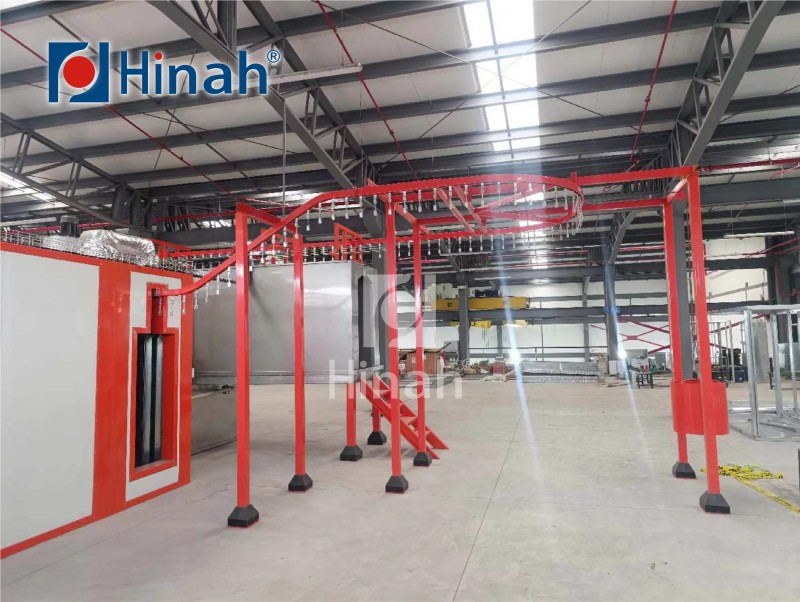
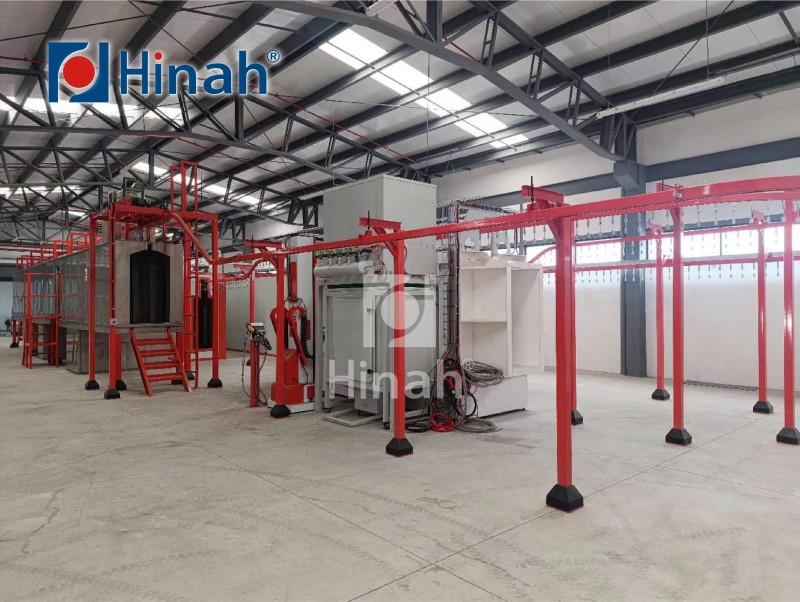
Thermal Management: Optimizing the Dry-Off Stage for the Powder Coating Line
The dry-off oven bridges the gap between the wet wash and the dry spray booth. If you do not manage heat and airflow correctly here, you compromise the chemistry you just applied. Proper thermal management ensures the workpiece is bone-dry and at the correct temperature before it continues through the powder coating line.
Substrate Exit Temperature
Many operators ignore the temperature of the part as it leaves the dry-off oven. If the metal istoo hot (above 50°C), the powder may “pre-gel” as it hits the surface. This ruins the “wrap” ofthe powder around edges and prevents a smooth finish. Conversely, if the part is too cold,moisture may remain in the pores of the metal. You must tune your powder coating line so theparts have enough time to cool slightly before they reach the automatic spray guns.
Eliminating Moisture Traps
Complex parts with folds, tubes, or blind holes act as “water traps.” If liquid water enters the powder booth, it creates steam during the final cure, causing bubbles and pinholes. You must position your dry-off nozzles to hit these recessed areas directly. High-velocity air curtains at the oven entrance help strip bulk water off the parts, allowing the heat to evaporate the remaining film more efficiently.
Flash-Off Zone Management
The “Flash-Off” zone is the space between your final rinse and the dry-off oven. If this zone is too long, the parts might develop flash rust in the open air. If it is too short, the sudden high heat of the oven can cause “boiling” of the surface moisture, which disrupts the phosphate layer. A well-engineered powder coating line maintains a controlled humidity in this transition zone to keep the surface stable.
Airflow and Contamination
The dry-off oven must be a clean environment. High-speed fans circulate hot air to speed up evaporation, but they can also blow dust onto the wet, sensitive metal. You must use high-temperature HEPA filters and maintain slightly positive air pressure. This prevents factory dust from being sucked into the oven and sealing contaminants onto the part before it travels further down the powder coating line.
Troubleshooting the “Hidden” Variables
Beyond the obvious chemical and mechanical settings, two “hidden” variables often disrupt a powder coating line. First, water hardness plays a silent but destructive role. High levels of calcium and magnesium in your local water supply can neutralize surfactants in your degreaser and cause scale buildup in your nozzles. This scale reduces impingement force and leaves white streaks on the metal. Second, biological contamination can ruin your results. Recycled wash water often hosts anaerobic bacteria that create acidic byproducts. these microbes attack the metal surface and degrade the chemical tanks, leading to foul odors and poor coating adhesion. You must test your water source regularly and use biocide treatments to maintain a truly clean environment for your powder coating line.