
Home » Products » Manual Powder Coating Line » Manual Powder Coating Line for Large-scale Steel Structure
Manual Powder Coating Line for Large-scale Steel Structure
Flexible and efficient e-coating system.
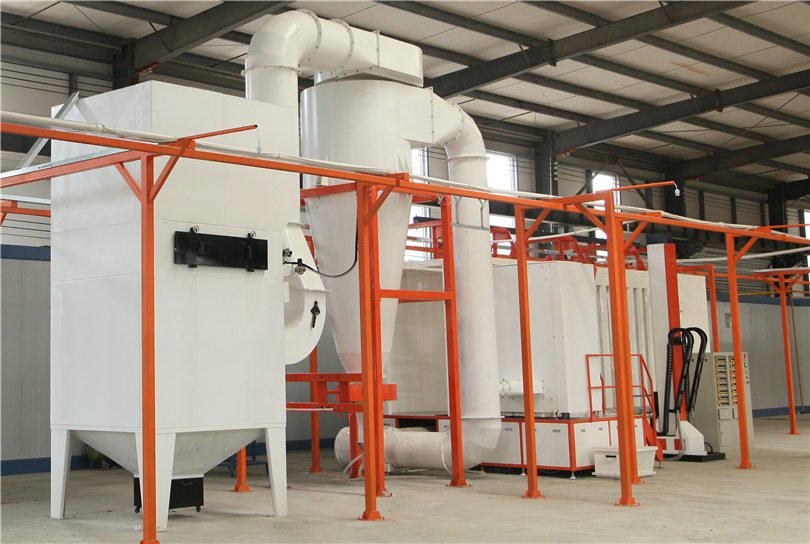
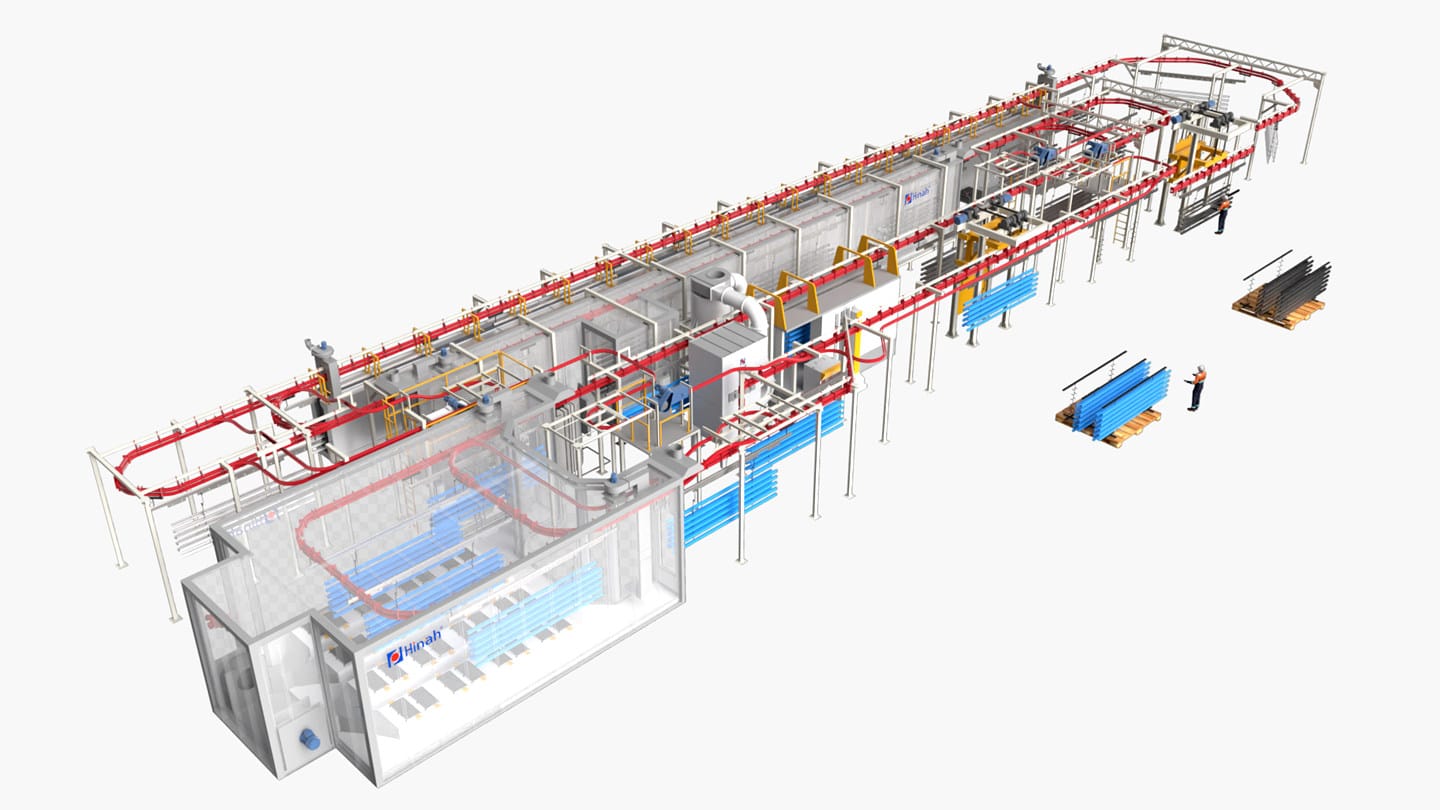
Process Flow: Loading– Pre-Treatment –Drying–Manual Powder Coating –Curing –Cooling –Unloading
1. Workpiece Name: Large-scale Steel Structure
2. Maximum Size: L7000 × W1500 × H1700 mm
3. Area Size: 89 m × 15 m
4. Heating Method: Natural Gas
5. Conveying Specifications: Semi-auto Type

A large steel structure is not a scaled-up cabinet. A welded H-beam or a box column is 6 to 20 mm thick, weighs several hundred kilos per member, and carries two kinds of surface that cannot be treated the same way: the exposed faces that have to survive weather, and the contact faces at bolted connections that must stay bare to carry friction. Between them sit weld toes, stiffener plates, and webs deep enough that no gun angle reaches the root.
Members are moved by overhead crane and hoist slide, not on a conveyor hanger. Each member is slung at two points to keep it level, sprayed on one side, then turned by the crane with a sling through the lifting lugs rather than contact with the coated faces, so the second side is reached without a second pass over the first. On long members the slinging points matter: lift a 7 m beam at its ends and it bows in the middle under its own weight, and the film on the sagging face runs before the oven.
The sequence starts at weld toes and edges, because those are where the film will be thinnest if left until last. Then the webs, sprayed from the bottom upward so that overspray lands on coated surface instead of dry powder landing on bare steel. Flange faces come last, and the contact faces at the connection are masked before the member enters the booth.
Large members are usually prepared by abrasive blasting to Sa 2½ rather than by a multi-stage chemical line: there is no tank long enough, and mill scale left on hot-rolled steel is the most common reason a coating delaminates two years after installation. Blasting also leaves the anchor profile the powder needs to key into.

What a large steel structure demands from the coating process
Members are built from hot-rolled plate and section between 6 mm and 20 mm, welded into H-beams, box columns, trusses and base frames. Plate thickness is not uniform across a single member: a 20 mm flange welded to an 8 mm web is two different thermal masses in one workpiece.
The geometry works against line-of-sight coating. A box column has four faces and an internal void; an H-beam has two inner faces between its flanges; a truss has joints where three members meet at an angle no nozzle can square up to. Spray distance and angle both change across the member, and the operator follows the geometry rather than walking a fixed path.
Two constraints are mechanical rather than cosmetic. Slip-critical bolted connections rely on friction between bare steel faces, so the faying surface and the bolt holes must stay uncoated — film there reduces the clamp load the joint was designed for. Lifting lugs and crane eyes are the same kind of feature. And a member that will not fit on site because 200 μm of film closed a tolerance is a member that gets ground back and touched up in the field.
A typical specification for structural steel: blast to Sa 2½ to ISO 8501-1, a zinc-rich or epoxy powder primer where specified, then a powder topcoat at 80–120 μm for C3 and 120–160 μm for C4 to ISO 12944-2. Thickness is measured to ISO 19840 on the blasted surface, adhesion to ISO 2409 or ASTM D3359, and neutral salt spray to ISO 9227 at 480–720 hours depending on the corrosivity category.
The three defects that decide whether a member passes
1. Uncured film at the web-to-flange junction. The weld and the two plates meeting there form a heat sink. Metal temperature along that line lags the rest of the member through the whole oven, and a cure schedule set on the flange leaves the junction undercured. The film looks acceptable and chalks off within a year. The countermeasure is to control on part temperature rather than oven air temperature, and to hold at the junction’s ramp rather than the flange’s.
2. Thin film in deep webs and box sections. Powder is charged and follows field lines, so an enclosed corner sees less powder than the open face beside it — the Faraday cage effect at structural scale. The outer flange reads acceptable and the inside of the web reads 30 μm. The fix is gun angle and a second pass into the void before the member is turned, not more powder on the outside.
3. Missing coverage at weld toes and sheared edges. A weld toe is a concave-to-convex transition and powder pulls back from it during flow; a sheared edge is close to a knife edge with almost no surface to hold film. Both are where corrosion starts, and both are the first place an inspector puts a gauge.
A fourth point is masking discipline, and it is where most rework comes from: faying surfaces, bolt holes, lifting lugs, earthing points and machined pads all have to be plugged or taped before the member enters the booth, and the tape has to survive the oven without leaving adhesive in the joint. Mill scale that survived the blast fails the same way — as an adhesion failure that is usually found after the part is installed.
What we need to size the line
Every line here is built to the workpiece. What we need from you: the largest member (length × width × height) and its weight, the plate thickness range, daily output in tonnes or members per shift, whether pre-treatment is blasting or chemical, the film thickness and corrosivity category your project specifies, and whether coating happens in your shop or on site.
- All Types Of Equipment For Powder Coating Lines
- Any Size According To Customer's Requirements
- Production Within 45-90 Days
- Delivery And Professional Installation
- 24 Months Warranty And Lifetime Service
Proven
30 years of experience providing proven equipment
Lifetime Service
Maintenance is more important than repair
Maximum Efficiency
Production line capacity fully matches demand without wasting any resources
Contact Us -- Free Design & Order Equipment Calculation
Order Equipment Calculation
In Order To Provide You With The Best Solution, Please Tell Us The Following Information
● Factory Dimensions (length, width, height)
● Work Piece Output (1 day = 8 hours, 1 month = 30 days)
● Material of the workpieces
● Dimensions of work piece
● Weight of the workpieces
● Color Change Demand (Frequency)
We closely communicate with clients to understand their needs and provide tailored solutions. Once the solution fits their requirements, we customize the production of the powder coating line to help them adapt to their specific production environment and coating needs.
/CONTACT US
Want to Discuss Your Upcoming Product Line?
Hinah coating will help you get things done.
Email us
Tel (Whatsapp/Wechat)
+86-186 3213 8668
Learn How We Helped 1000+ Customers Gain Success.